Musings about politics, movies, music, art and all the other important things in life.

Showing posts with label David Ivers. Show all posts

Tuesday, August 3, 2010

Live Theater, take 2

(NOTE: If you haven't read yesterday's post, Why I Love Live Theater, please read it first.)

This last week, I had the chance to see Brian Vaughn and David Ivers in another play, The 39 Steps. The play has some similarities in approach in that several of the actors have to play many roles. At the beginning of the play, one of the actors – in this instance, it was again Ivers – is an M.C. addressing the audience as if we are the audience in a vaudeville-type show featuring an act called “Mr. Memory.”

Mr. Memory has committed thousands and thousands of facts to his brain. Part of the performance calls for Ivers, as the M.C., to invite men and women to call out questions for Mr. Memory. During the matinee performance that I watched July 30th, one of the real audience members became so involved she thought the M.C. was waiting for us to shout out questions. So as Ivers paused briefly, she yelled out, “What’s my name?” Without missing a beat, Ivers said, “There’s a script.” As we all laughed, he smiled, then said, “But if you’re having trouble they can help you in the lobby.” More laughter – and then the action continued. You never know what will happen during a live performance.

The next day, Ivers and Vaughn were the speakers at an actors’ seminar – one of the many opportunities unique to the Utah Shakespearean Festival. Over its 49-year history, the Festival has fostered an air of familiarity such that actors, directors and others associated with the Festival mingle with patrons quite regularly and Festival patrons feel comfortable walking up and offering the obligatory fawning accolade. It isn’t unusual to run into the actor playing Hotspur in Henry IV, Part I on his way to the theater to get ready to play Lancelot in Camelot. The actors are generally gracious and appear to appreciate the comments from the common folk. Many actors also sneak in to the literary seminars (which happen the morning following the play performances) and listen to the attendees’ reactions to the performance. At the back, dressed in street clothes (and sometimes a baseball cap and/or sunglasses) they can sometimes eavesdrop incognito. This allows them to gauge the “true” reaction of audiences, unfettered by the layer of politeness we reserve in the presence of performers. Twice a week, USF invites a couple of the company’s actors to take to the podium to tell the seminar attendees their life stories and give insight into their craft and on July 31st, we were treated to the Ivers and Vaughn show.

One of the attendees brought up the incident during their performance the day before and Ivers shared that in the month and a half since they’d begun preview performances of The 39 Steps no one had shouted out a question. His instantaneous reaction to the previous day’s interruption was all the more impressive given this information.

Besides a few behind-the-scenes stories and sharing some information about the vagabond life they’ve led in their professional careers, they also talked about the changes they are facing as they settle into their new roles as co-artistic directors of the Utah Shakespearean Festival. Most seminar attendees were happy to hear the news, but in the next moment were concerned this might force them to cut back on the number of productions in which they can perform. Vaughn, in particular, holds a special place in the hearts of many who are regular USF attendees because they feel as if they’ve watched him grow up over the years. Vaughn attended Southern Utah University, where the Festival is located, and began work as a professional actor in the Festival’s Greenshow in the early 1990s, before becoming an actor on the main stage. Because of the family atmosphere fostered at USF, many patrons view Vaughn as a son, grandson or brother, and pounce on news of his successes. For the past dozen years he’s been a resident actor with Milwaukee Repertory Theater, but is moving to Cedar City with his family to take on his new role. He and Ivers have remained close friends as their work has taken both around the country. They’ve shared the stage at USF many times in the past 15 years, culminating with Ivers directing Vaughn in a tour de force performance of Cyrano de Bergerac in 2008.

Of the two, Ivers appears to be more outgoing. He is extremely quick-witted and playful. Vaughn seems slightly more reserved, but equally charming. The two were gracious to seminar attendees who asked questions about their past, their future plans and their mutual craft. They promised to continue to take on new roles as often as their new jobs would allow.

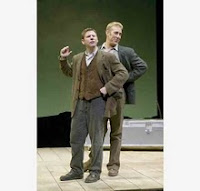
Picture: David Ivers, Brian Vaughn and Aaron Galligan-Stierle (L-R) in The 39 Steps at the Utah Shakespearean Festival

Monday, August 2, 2010

Why I Love Live Theater

From time to time I’ll meet someone who has never seen a play performed in a theater – not little church productions, community theater or a regional theater production, let alone a Broadway play. This is something I cannot understand. I cut my teeth on Shakespeare at five years old, when I saw my first production of Romeo and Juliet. Sure, it started long after my 7:00 bedtime, and yes, I did fall asleep through a good portion of it, but I do remember watching my father play Capulet, Juliet’s father, in full Shakespearean garb. Not long after, he played Claudius (Hamlet’s uncle) in Hamlet. It is a little disconcerting to see your own father play the bad guy when you are still at an age when he can do absolutely nothing wrong. (Fortunately I was old enough to understand that this was all pretend.)

By then, I’d been bitten by the world of the theater – this magical land where you can be transported to a new time and a new place through the help of great acting, great staging and a little bit of imagination. You walk into a theater with all of your baggage: the cares of the world, the worries of the day. But you walk out (it is hoped) having seen a work of art that has changed your perception of the world and the people in it. That’s what all artists and performers wish to do, either on a small scale or a large one. Or, as Shakespeare wrote:

...To hold as 'twere the
mirror up to nature: to show virtue her feature, scorn her own
image, and the very age and body of the time his form and pressure.
(Hamlet; Act 3, Scene 2)

But that’s only one aspect of it, the idea of theater as art. Because you can go to a good movie or read a good book and achieve the same effect. Live theater also brings things the other two cannot – the element of the unexpected, the freshness of the shared experience and the newness of each performance. You can rehearse dozens of times, plan for many possible outcomes, but you can never anticipate every aspect of a live performance. The main reason for this is that one thing is changing at every performance – the audience. No two audiences are alike. Each group of people will react differently, laugh in slightly new ways at unexpected places in the script, and bring their own set of problems into the theater.

My favorite example of this is the time I saw Stones in His Pockets at the Utah Shakespearean Festival in the summer of 2005, starring David Ivers and Brian Vaughn and directed by the great J.R. Sullivan. The two actors play all of the roles – several dozen each, both male and female. There are minimal costume changes, few props and almost no set decorations. The play derives its energy and pace entirely on the skills of the two actors and their ability to suck you into the plot, time and location. Even in the hands of skilled and talented actors such as Ivers and Vaughn, this is not an easy thing to do.

Mid-way into this particular performance, a woman at the front of the theater had an asthma attack and began to wheeze loudly, falling to the floor at the front of the stage and interrupting the performance. The actors stopped and everyone else was silent for a few moments as we were pulled away from the play’s action. Was this part of the play? Obviously not as the actors had stopped and were staring at the woman, slightly dumbstruck. Ivers, who noticeably had dropped character in seconds, observed what was happening and then took charge. “Can we get the house lights please?” The house lights came up almost immediately. Then, “Is there a doctor in the house?” He said the words to elicit help for the woman, but also to cut the tension somewhat. Nervous laughter tittered through the packed house as a couple of people sprinted to the front to help the woman. Several moments later, Ivers turned to his co-star Vaughn, and asked him to get some water for the woman, which he did. The audience members, as if by some silent decree or mutual understanding, stayed very quiet, remained in their seats, and waited for the woman’s medical crisis to resolve. Several minutes later, the attack was over and the woman returned to her seat.

During the ensuing minutes, Ivers and Vaughn walked off stage, then returned and engaged in muffled conversation. It was obvious they didn’t know what to do. How do you restart the action in the middle of a play where there are no scene breaks? Where the action flows imperceptibly from one vignette to the next as the actors inhabit many different personae? They were already many minutes into the second half and it would be odd to begin the second act all over again. Finally, Ivers spoke to the audience again. “We’re trying to figure out where to start,” he said to more laughter.

Then the stage manager broke in – the voice of God over the loudspeaker. “Let’s begin with so-and-so’s entrance.” The two actors nodded. I thought: “So-and-so’s entrance? No one enters the stage in this play – how are they going to do that?” In seconds the house lights came down again and the only focus was on the two actors on stage who were momentarily pausing and returning to the action. Then the figurative curtain lifted and they were again in character, picking up the action with the “entrance” of one character into the action already happening on stage.

It was a bit surreal, but an amazing glimpse into the actors’ process and a way to see them as real people, not just characters on a stage. It gave me a new level of appreciation for two actors who already had my respect for their immense talent. More on this tomorrow.

Picture: Brian Vaughn and David Ivers (L-R) in Stones in His Pockets, Utah Shakespearean Festival, 2005