Musings about politics, movies, music, art and all the other important things in life.

Tuesday, August 3, 2010

Live Theater, take 2

(NOTE: If you haven't read yesterday's post, Why I Love Live Theater, please read it first.)

This last week, I had the chance to see Brian Vaughn and David Ivers in another play, The 39 Steps. The play has some similarities in approach in that several of the actors have to play many roles. At the beginning of the play, one of the actors – in this instance, it was again Ivers – is an M.C. addressing the audience as if we are the audience in a vaudeville-type show featuring an act called “Mr. Memory.”

Mr. Memory has committed thousands and thousands of facts to his brain. Part of the performance calls for Ivers, as the M.C., to invite men and women to call out questions for Mr. Memory. During the matinee performance that I watched July 30th, one of the real audience members became so involved she thought the M.C. was waiting for us to shout out questions. So as Ivers paused briefly, she yelled out, “What’s my name?” Without missing a beat, Ivers said, “There’s a script.” As we all laughed, he smiled, then said, “But if you’re having trouble they can help you in the lobby.” More laughter – and then the action continued. You never know what will happen during a live performance.

The next day, Ivers and Vaughn were the speakers at an actors’ seminar – one of the many opportunities unique to the Utah Shakespearean Festival. Over its 49-year history, the Festival has fostered an air of familiarity such that actors, directors and others associated with the Festival mingle with patrons quite regularly and Festival patrons feel comfortable walking up and offering the obligatory fawning accolade. It isn’t unusual to run into the actor playing Hotspur in Henry IV, Part I on his way to the theater to get ready to play Lancelot in Camelot. The actors are generally gracious and appear to appreciate the comments from the common folk. Many actors also sneak in to the literary seminars (which happen the morning following the play performances) and listen to the attendees’ reactions to the performance. At the back, dressed in street clothes (and sometimes a baseball cap and/or sunglasses) they can sometimes eavesdrop incognito. This allows them to gauge the “true” reaction of audiences, unfettered by the layer of politeness we reserve in the presence of performers. Twice a week, USF invites a couple of the company’s actors to take to the podium to tell the seminar attendees their life stories and give insight into their craft and on July 31st, we were treated to the Ivers and Vaughn show.

One of the attendees brought up the incident during their performance the day before and Ivers shared that in the month and a half since they’d begun preview performances of The 39 Steps no one had shouted out a question. His instantaneous reaction to the previous day’s interruption was all the more impressive given this information.

Besides a few behind-the-scenes stories and sharing some information about the vagabond life they’ve led in their professional careers, they also talked about the changes they are facing as they settle into their new roles as co-artistic directors of the Utah Shakespearean Festival. Most seminar attendees were happy to hear the news, but in the next moment were concerned this might force them to cut back on the number of productions in which they can perform. Vaughn, in particular, holds a special place in the hearts of many who are regular USF attendees because they feel as if they’ve watched him grow up over the years. Vaughn attended Southern Utah University, where the Festival is located, and began work as a professional actor in the Festival’s Greenshow in the early 1990s, before becoming an actor on the main stage. Because of the family atmosphere fostered at USF, many patrons view Vaughn as a son, grandson or brother, and pounce on news of his successes. For the past dozen years he’s been a resident actor with Milwaukee Repertory Theater, but is moving to Cedar City with his family to take on his new role. He and Ivers have remained close friends as their work has taken both around the country. They’ve shared the stage at USF many times in the past 15 years, culminating with Ivers directing Vaughn in a tour de force performance of Cyrano de Bergerac in 2008.

Of the two, Ivers appears to be more outgoing. He is extremely quick-witted and playful. Vaughn seems slightly more reserved, but equally charming. The two were gracious to seminar attendees who asked questions about their past, their future plans and their mutual craft. They promised to continue to take on new roles as often as their new jobs would allow.

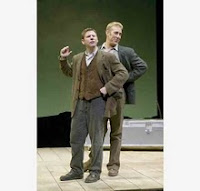
Picture: David Ivers, Brian Vaughn and Aaron Galligan-Stierle (L-R) in The 39 Steps at the Utah Shakespearean Festival

Monday, August 2, 2010

Why I Love Live Theater

From time to time I’ll meet someone who has never seen a play performed in a theater – not little church productions, community theater or a regional theater production, let alone a Broadway play. This is something I cannot understand. I cut my teeth on Shakespeare at five years old, when I saw my first production of Romeo and Juliet. Sure, it started long after my 7:00 bedtime, and yes, I did fall asleep through a good portion of it, but I do remember watching my father play Capulet, Juliet’s father, in full Shakespearean garb. Not long after, he played Claudius (Hamlet’s uncle) in Hamlet. It is a little disconcerting to see your own father play the bad guy when you are still at an age when he can do absolutely nothing wrong. (Fortunately I was old enough to understand that this was all pretend.)

By then, I’d been bitten by the world of the theater – this magical land where you can be transported to a new time and a new place through the help of great acting, great staging and a little bit of imagination. You walk into a theater with all of your baggage: the cares of the world, the worries of the day. But you walk out (it is hoped) having seen a work of art that has changed your perception of the world and the people in it. That’s what all artists and performers wish to do, either on a small scale or a large one. Or, as Shakespeare wrote:

...To hold as 'twere the
mirror up to nature: to show virtue her feature, scorn her own
image, and the very age and body of the time his form and pressure.
(Hamlet; Act 3, Scene 2)

But that’s only one aspect of it, the idea of theater as art. Because you can go to a good movie or read a good book and achieve the same effect. Live theater also brings things the other two cannot – the element of the unexpected, the freshness of the shared experience and the newness of each performance. You can rehearse dozens of times, plan for many possible outcomes, but you can never anticipate every aspect of a live performance. The main reason for this is that one thing is changing at every performance – the audience. No two audiences are alike. Each group of people will react differently, laugh in slightly new ways at unexpected places in the script, and bring their own set of problems into the theater.

My favorite example of this is the time I saw Stones in His Pockets at the Utah Shakespearean Festival in the summer of 2005, starring David Ivers and Brian Vaughn and directed by the great J.R. Sullivan. The two actors play all of the roles – several dozen each, both male and female. There are minimal costume changes, few props and almost no set decorations. The play derives its energy and pace entirely on the skills of the two actors and their ability to suck you into the plot, time and location. Even in the hands of skilled and talented actors such as Ivers and Vaughn, this is not an easy thing to do.

Mid-way into this particular performance, a woman at the front of the theater had an asthma attack and began to wheeze loudly, falling to the floor at the front of the stage and interrupting the performance. The actors stopped and everyone else was silent for a few moments as we were pulled away from the play’s action. Was this part of the play? Obviously not as the actors had stopped and were staring at the woman, slightly dumbstruck. Ivers, who noticeably had dropped character in seconds, observed what was happening and then took charge. “Can we get the house lights please?” The house lights came up almost immediately. Then, “Is there a doctor in the house?” He said the words to elicit help for the woman, but also to cut the tension somewhat. Nervous laughter tittered through the packed house as a couple of people sprinted to the front to help the woman. Several moments later, Ivers turned to his co-star Vaughn, and asked him to get some water for the woman, which he did. The audience members, as if by some silent decree or mutual understanding, stayed very quiet, remained in their seats, and waited for the woman’s medical crisis to resolve. Several minutes later, the attack was over and the woman returned to her seat.

During the ensuing minutes, Ivers and Vaughn walked off stage, then returned and engaged in muffled conversation. It was obvious they didn’t know what to do. How do you restart the action in the middle of a play where there are no scene breaks? Where the action flows imperceptibly from one vignette to the next as the actors inhabit many different personae? They were already many minutes into the second half and it would be odd to begin the second act all over again. Finally, Ivers spoke to the audience again. “We’re trying to figure out where to start,” he said to more laughter.

Then the stage manager broke in – the voice of God over the loudspeaker. “Let’s begin with so-and-so’s entrance.” The two actors nodded. I thought: “So-and-so’s entrance? No one enters the stage in this play – how are they going to do that?” In seconds the house lights came down again and the only focus was on the two actors on stage who were momentarily pausing and returning to the action. Then the figurative curtain lifted and they were again in character, picking up the action with the “entrance” of one character into the action already happening on stage.

It was a bit surreal, but an amazing glimpse into the actors’ process and a way to see them as real people, not just characters on a stage. It gave me a new level of appreciation for two actors who already had my respect for their immense talent. More on this tomorrow.

Picture: Brian Vaughn and David Ivers (L-R) in Stones in His Pockets, Utah Shakespearean Festival, 2005

Monday, August 3, 2009

Books Are Forever

One of the first posts I made on this blog was about the Amazon Kindle -- the ebook reader that purports to let you carry an entire library in a hand-held computer. While I love my technology, the whole idea of the Kindle makes my eyes hurt.

Now comes news that shows my initial abhorence was spot on. Apparently Amazon didn't get its ducks in a row before it offered several George Orwell novels for download as ebooks. So instead of working out the situation with the copyright holders, what did Amazon do? It unilaterally deleted copies of the books from subscribers' Kindles. Now Amazon is facing a class action lawsuit.

One of the plaintiffs, Justin Gawronski, has a compelling story about his experience with Amazon's memory hole. Apparently, he was reading his copy of 1984 as a summer assignment for school, and had been using one of the Kindle's selling points—the ability to attach notes to specific parts of the e-book text—to prepare for his return to school. Since he was actively reading the work when Amazon pulled the plug, he actually got to watch the work vanish from his screen. He's left with a file of notes that are divorced from the text that they reference.

So even though Amazon claimed you would always have the books that you bought (even if something happens to your Kindle reader), that turns out to be false. The company can delete the books at will. The Orwell incident (ironic, isn't it?) isn't the only case where the company can take away your books when it wants. Earlier this year, it came out that Amazon can delete your Kindle account whenever it wants to. One Amazon customer found that out the hard way when he made one too many returns.

So what happens when your Kindle account is taken away? Your Kindle still works, and the books you already bought for it will work, but you can't download those books ever again (better have made a backup on your PC!), you can't receive your magazine, blog, or newspaper subscriptions on it anymore, you can't email documents to Amazon to have them converted and sent to your Kindle, and you can't buy any new books for the device. That $360 device only works so long as Amazon decides it will work.

All of this just proves my point even more: they'll never take away my books.

Friday, July 31, 2009

Easily Distracted

Lately I’ve been thinking a lot about how easily distracted we become. “Everyone” is concerned about health care and 2/3 of all Americans want health care reform, including some sort of universal health care, but our congress takes months and months to act. We become frustrated by the slow, messy process of legislating the mess (which some have likened to making sausage) and get distracted but other things – often very silly things. So we end up with a watered down version of what we really want that never does anything; and the rich get richer, the poor get poorer, and we’re all unhappy.

The biggest problem is that most of the time we cannot focus on more than one thing at once, and let’s face it, the problems have been pretty big over the past year. We tend to look for any excuse to escape, so we are distracted by really stupid stuff. The 24/7 nature of news nowadays only makes the problem worse. News organizations have to constantly “feed the beast” – fill air time or post new items to their Web sites.
Having worked in television, I can attest it isn’t some basic conspiracy. But we are like sheep, easily led astray – staring at the guy waving a sign that says “look over here.” Usually it has to do with celebrity gossip, sports, or – most likely – being much more concerned with our own problems than with the “big picture” problems. I’m not sure how to solve this, but here are three simple things that might help.
  1. Get informed, diverse news and opinion. Having more ways to get our news is a very positive thing – I firmly believe that. Looking for information from multiple sources is also a good way to keep from simply confirming any bias you already have. It helps to get alternate perspectives and to question what you hear or read.
  2. Accept that there is usually a legitimate, alternate viewpoint. Anyone who has ever been involved in a news story will tell you that the news entity got the story wrong. This is because bias and perspective play a huge part in how we understand anything. If news reporting were just about reporting “facts” we would never have any news.
  3. Expect and demand accountability from news media. Write to news editors and journalists and ask them to focus on the things that really matter. Tell them what you think – but do it in a respectful, constructive manner – and make sure you sign your correspondence, including contact information. Nowadays, the majority of so-called feedback that news media get is anonymous, nasty in tone and completely discounted. Signing correspondence insures that you’ll be taken seriously and that you will be respectful to the recipient.

I guess it goes back to what my teachers always said about politics in general: if you don’t like what’s happening, get involved, get in the game, and stop standing by the sidelines.

Monday, July 27, 2009

Why Do Men Like to Tease?

I used to think they pulled baby boys aside at birth and slid them a handbook on the flair and function of teasing their sisters with style. I had plenty of experience with teasing, practically from the time I was born. I have both an older and a younger brother and they practiced their skills on all four of their sisters.

My older brother elevated teasing to an art form – spending hours, even days, executing his particular brand of devilry. He’d speak to the middle of my forehead all day or call me any strange nickname he could think up or make fun of one physical attribute or another. In hindsight, pretty stupid stuff. But it’s enough to drive a seven- (or eight- or nine-) year-old to distraction.

My mother’s response was consistent: “Just ignore him!” I love my mother, but this advice was dreadful for obvious reasons. First is the essence of my brother’s nature. He is stubborn – even more stubborn than I am. Second, and more importantly, is the essence of my nature. I cannot hide my feelings. I am the world’s worst poker player. One high school English teacher said you could read my entire day on my face. Now imagine the combination of these two aspects in our respective personalities. If I had somehow managed to “ignore him” without for a moment imparting any emotion on my face – a feat that’s like climbing Everest for me – my brother’s response would be to try even harder to get a rise out of me. He would see it as an immense challenge worthy of conquering. Sadly, I never gave him such a challenge. Ignoring him is a practical impossibility.

My younger brother is also an expert tease, but he has his own unique style. Being a dozen years older, I avoided the brunt of his teasing, at least until he grew taller than me. When we could finally see eye-to-eye, he started pushing on the top of my head, to help me shrink enough so that I’d be shorter than him. Then he’d play word games, being deliberately obtuse and “misunderstanding” something I’d said to the point of ridiculousness. He still loves that game.

My brothers gave me a lot of practice dealing with the fine art of the tease. But I quickly learned the practice isn’t exclusive of sisters. Boys, in general, love to tease. They love getting a rise out of us and seeing us get all in a dither.

Most of the women I know don’t like this much. It’s irritating. It makes you uncomfortable. It brings out the worst in us. So why do it?

For my brothers, I can only guess that they couldn’t inflict any physical harm (no wrestling, no tackling, no hitting your sisters), so they resorted to a little mental torment. All siblings like to fight, and this is a good way to get your licks in without doing any physical damage.

But what about adult men? Is it a form of flirting? A way to get our attention? Going back to Mom, her response would be a resounding, “Yes. He’s only teasing you because he likes you!” That’s probably true, but aren’t there better ways of getting our attention?

Looking back, the tormenting from brothers probably prepared me for the strange teasing and games that happen in the adult world: in interpersonal relationships as well as the corporate world.

So why do men like to tease?

The only logical answer I can come up with is – because they find it so much fun.

Monday, May 11, 2009

Taking a Stand

Yesterday I got together with my parents for Mother's Day, like a dutiful daughter. Amazingly, the topic turned to... torture. Sounds strange on a day when you're supposed to be celebrating Mom, but in our family, discussions often turn to politics, religion and other taboo subjects.

I've been mulling over the whole torture issue for several weeks, since President Obama declassified the memos advancing the Bush administration's case to use torture on suspected terrorists in response to a FOIA request from the ACLU. The memos are a legal response, justifying all kinds of "harsh interrogation methods" to extract information from terror suspects. I hate even using that euphemism (which many in the media seem hell-bent on doing) because it almost seems to side with those who would use any means to justify their behavior, and I don't think there is any justification for this. It is torture. We treated other human beings this way.

The Bush administration used these memos to make the case that what they were doing wasn't torture. But if one of our soldiers had been water-boarded, slammed against a wall, deprived of sleep, food and clothing, then shut in a box with crawling insects, you'd better believe we would be screaming about the torture that soldier had to endure. (This is precisely what happened in many of the cases outlined in the memos.)

I thought our country was better than this. In the past, we always said that we were better based on the fact that we didn't treat people this way. We didn't treat Japanese POWs this way during World War II, even though many of our soldiers were tortured in Japan's POW camps. We prosecuted U.S. soldiers in Viet Nam following the My Lai massacre. We could always hold our heads high and say that we wouldn't do the things the enemy does. Anyone who stepped out of line was held to account.

Yesterday, the former vice president was on the Sunday morning talk shows - again - to defend what he and others in the Bush administration ordered following 9/11. Former Vice President Cheney still maintains what they did was not torture, although his defense mainly centers around the idea that their waterboarding of suspects did elicit information. Despite his protests, there is evidence that this is not true. Still, this is a canard. Whether or not it gave us good information, do we want to be a country - a people - of torture?

My discussion with the parental units was also interesting because we haven't really talked about this issue yet and still we'd come to the same conclusion: this is absolutely horrible, and why aren't more people upset about it? Independently, we'd all read a fantastic op-ed from Leonard Pitts of The Miami Herald on May 6th when it was printed in The Salt Lake Tribune. Pitts' concern is also that more people, and Christians in particular, are not taking a stand against torture.

As my parents and I discussed it, Dad (who happens to be a Biblical scholar with a PhD in religion) was especially saddened and said, "Why is it that we Christians throughout the ages seem to come down on the wrong side of things? The Crusades, the Inquisition, slavery, now this."

There's still time, though. We don't have to be forever known as a people of torture. As Americans, we can say that we won't condone this any longer. We can ask our political leaders for an independent investigation that will get to the bottom of this. As Christians, we can ask our religious leaders to stand up in opposition to this treatment of other human beings. We can ask them to speak out from a perspective of faith.

Finally, as a Christian, I can ask my ultimate question: "Who would Jesus torture?"


Monday, March 2, 2009

Life with Beagles

When people have children, they force their unsuspecting (single) friends to watch countless hours of video of their obviously fabulous offspring and sit through endless scrapbooks highlighting their amazing antics. Since I have no children, I've never been able to reciprocate. My new digital camera changes this. I have managed to create a very short video of my roommate, Brontë.

A little background: Brontë is 10 years old and she is a beagle, which means she doesn't greet you with hugs and kisses when you come home, she greets you with a howl. Well, for hound dogs, it's called baying. Brontë is very, very good at baying. I think it's her way of leveling the playing field since she has no opposable thumbs. As her vet says, Brontë is very good at asserting her rights, whatever she deems them to be.

Note: Please forgive the quality - I'm still learning how to use the camera and the editing equipment.